

Architecture
Nuclei is three processes pretending to be one app: a Rust shell, a React
frontend in the shell’s WebView, and a Python kernel subprocess. The
frontend never touches Python directly — everything quantum goes over a
localhost WebSocket. Dirac (the AI layer) never touches a Nuclei server —
the frontend calls api.anthropic.com directly with a user-supplied key.
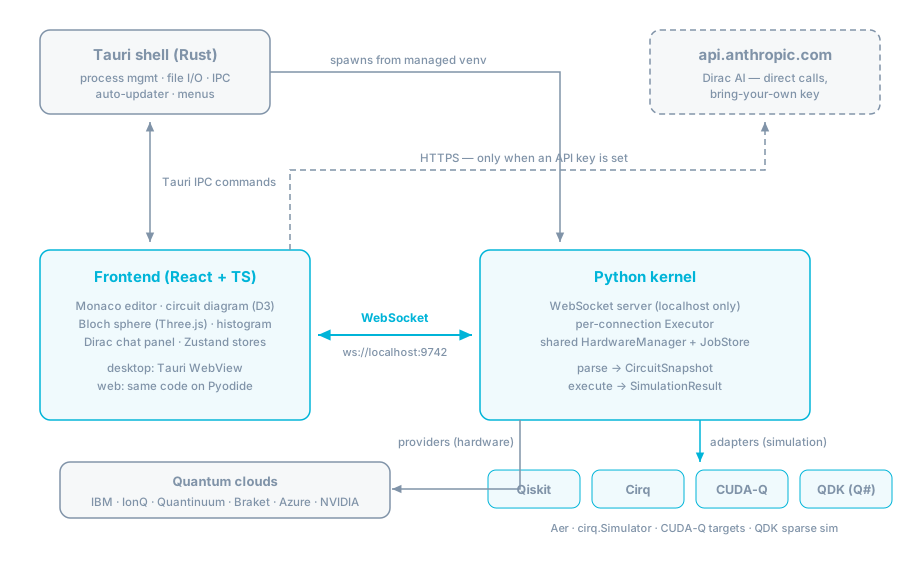
The three layers
Section titled “The three layers”| Layer | Code | Responsibilities |
|---|---|---|
| Tauri shell (Rust) | src-tauri/ | Spawns and supervises the kernel process, manages the per-user Python venv, file system access, typed IPC commands, auto-updater, native menus |
| Frontend (React + TypeScript) | src/ | Monaco editor, D3 circuit diagram, Three.js Bloch sphere, histogram, Dirac chat, Zustand stores. Also ships as the browser build — see desktop vs web |
| Python kernel | kernel/ | WebSocket server, framework detection, adapters that normalize circuits to CircuitSnapshot, simulation, hardware submission |
Critical path
Section titled “Critical path”- You type in Monaco. After a debounce (default 300 ms, configurable in
Settings → Kernel), the frontend sends
{type: "parse", code, language}over the WebSocket. - The kernel resolves an adapter — explicit
languagehint first, then regex detection on the source (Q# syntax is checked before Python imports) — and extracts aCircuitSnapshot: gate list, qubit count, depth. No simulation runs on parse. - The frontend re-renders the circuit diagram from the snapshot. This loop runs on every pause in typing.
- On Cmd+Enter (Ctrl+Enter), the frontend sends
{type: "execute", code, shots, language}. The kernel runs the full simulation and replies with aSimulationResult— statevector, probabilities, sampled counts, per-qubit Bloch coordinates. - The Bloch sphere and histogram panels update from the result.
Message-by-message detail lives in the Kernel API reference.
Process model
Section titled “Process model”- Spawn. On startup the shell runs
ensure_kernel_runtime: create the managed venv if missing, rebuild it if its Python is older than 3.10, install the kernel’s import-time deps (websockets,numpy,keyring) if absent — then launcheskernel/server.pywith the venv’s interpreter. If the venv can’t be bootstrapped it falls back to systempython3. See install & build for the venv lifecycle. - Port. The kernel binds
localhostand prints exactly one ready line to stdout:Nuclei kernel ready on ws://localhost:<port>. Standalone embedders should parse that line — the kernel scans 9742–9761 if the default port is taken. The desktop app instead pins 9742, because the frontend’s WebSocket URL and the CSP both hardcode it. Before spawning, the shell reaps only a leftover kernel that Nuclei itself recorded; if anything else holds the port it refuses to start rather than kill an unrelated process. - Authentication. Every connection must pass a loopback
Hostcheck, anOriginallowlist and a first frame{"type": "authenticate", "token": ...}carrying a per-launch token (constant-time compare, never in the URL). The desktop shell generates the token and hands it to the frontend; a kernel started without a token refuses to run unlessNUCLEI_KERNEL_INSECURE_DEV=1is set. Unauthenticated or forbidden connections are closed with 4401 / 4403. - Connection. JSON text frames, 1 MiB inbound cap, WebSocket ping every 30 s with a 20 s pong timeout.
- Isolation. Each connection gets its own
Executor— parse/execute state never bleeds between clients. TheHardwareManager(provider connections, job registry) is deliberately process-global, shared across connections. - Logging. Kernel stdout/stderr are drained into the shell’s log file, so a kernel crash leaves a trace (see configuration for log paths).
Where extension code plugs in
Section titled “Where extension code plugs in”| You want to | Touch | Guide |
|---|---|---|
| Support a new quantum framework | kernel/adapters/ + the Rust catalog | Framework adapters |
| Submit to a new hardware cloud | kernel/hardware/ | Hardware providers |
| Drive the kernel from outside Nuclei | nothing — speak the protocol | Kernel API |
| Change Dirac’s behavior | src/hooks/useDirac.ts + src/services/ | Dirac architecture |